msgbartop
The rants and raves of a technogeek
msgbarbottom

msgbartop
msgbarbottom

22 Feb 10 Call Analytics – Beyond CDR analysis – Part I

“Oh, just get me the CDR’s and I’ll take it from there” – how many times have I heard these words before? I can’t even imagine the number of times in the past 15 years of IT/Telecom’s work that I’ve done and in the last 8 years of Asterisk in particular – when it comes to billing and fraud management, it would appear that the CDR’s are the Rosetta Stone of the industry.

Over the past 6 months, several of my friends and I had been asking ourselves this question: “Is there more to billing, fraud management and profit leakage? does it really all begins and ends with the CDRs?” – so, here we were, a group of 3 engineers dealing with telecom system and billing systems – we knew that the answer is a definite YES, however, how come most companies and system aren’t even aware of this, in such a way that causes them to leak telecom profits and waste their hard earned profit margins on simple accidental mis-interpretation of CDR records.

So, we’ve decided to sit down and start analyzing calls in real-time, trying to evaluate not only the CDR record that is received upon the completion of the call – but also understand the traversal path of the call, analyzing it in real time and evaluating it profit leakage potential. At the mean time, we’re concentrating our work on Asterisk, as it is the simplest for us to implement – however, we’re not focusing it only on that – we’ll looking at adding it to FreeSwitch, Yate, OpenSer/Kamailio, OpenSIPS and the various varients.

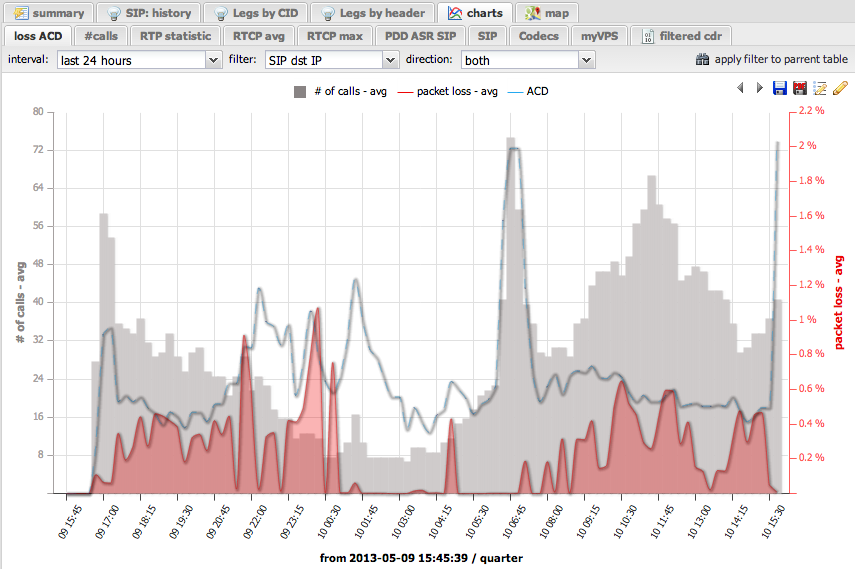
So, what have we done so far? well, one thing we never really had with any of the existing systems was a clear view of what’s going on “right-now” on our systems, so we said: “it would really be great if we could know how many call hits we’ve received during the past 15, 30, 45 or 60 minutes” – so here is what we made:

Inbound call statistics for 30 minutesThe above image shows our top 10 inbound DID numbers, as you can see these are in the 972 and 447 country codes (yes, we work mainly in Israel and the UK). At the backend, our servers are analyzing the data in real time, generating an active alert in the case a DID number’s statistics change in a somewhat drastic change, thus, establish a traffic anomaly. Another thing that interested us was our usage across multiple servers, which we are exhibiting in the below graph:

Traffic by server spread

Now, as you can see, the top graph shows a discrete anomaly:

Discrete traffic anomalyThis anomaly indicates something went wrong on all our servers between 00:45 and 1:15, which gives us a fairly discrete period of time to seek for a problem in the system. What happened was that one of the guys updated a portion of the data traversal API – basically deleting it :-) [we resumed full work after about 40 minutes].

So, where is it all going to? well simple, a new Open Source based service that we’ll be launching within a few months from now. Our intention is to provide a means for simple, straight forward, highly reliable, call analytics, fraud management and profit leakage analysis service. A service which is based upon a simple to use API on one hand and Open Source based data gathering agents. Our belief is that by analyzing large amounts of data, from multiple sources around the world, we’ll be able to ascertain the fingerprint of a telecom bound attack – being able to alert the respective users of the service and maybe in the later future, also provide a means to block the attack as it advances across the world.

I’ll be updating about our advancement as we go along, but for the time being, this is something I felt would interest you.

Reblog this post [with Zemanta]

Tags: , , , , , , ,

12 Feb 10 Beyond the dialtone – PBX user experience revisited

When most of us think about PBX systems, we usually associate these with cumbersome usage, confusing dialing codes and in most cases – a PBX system is automatically associated with the annoying task of transferring a call from one handset to another. Lately, I’ve been thinking deeply about how people use PBX systems, is this really the only way to use a PBX system? is there something else to the mix? can we really enrich one of the oldest operational paradigms in the world? – and for that matter, can the public be re-educated to assimilate a new breed of PBX systems or services?

Hardware-based IP phone
Image via Wikipedia

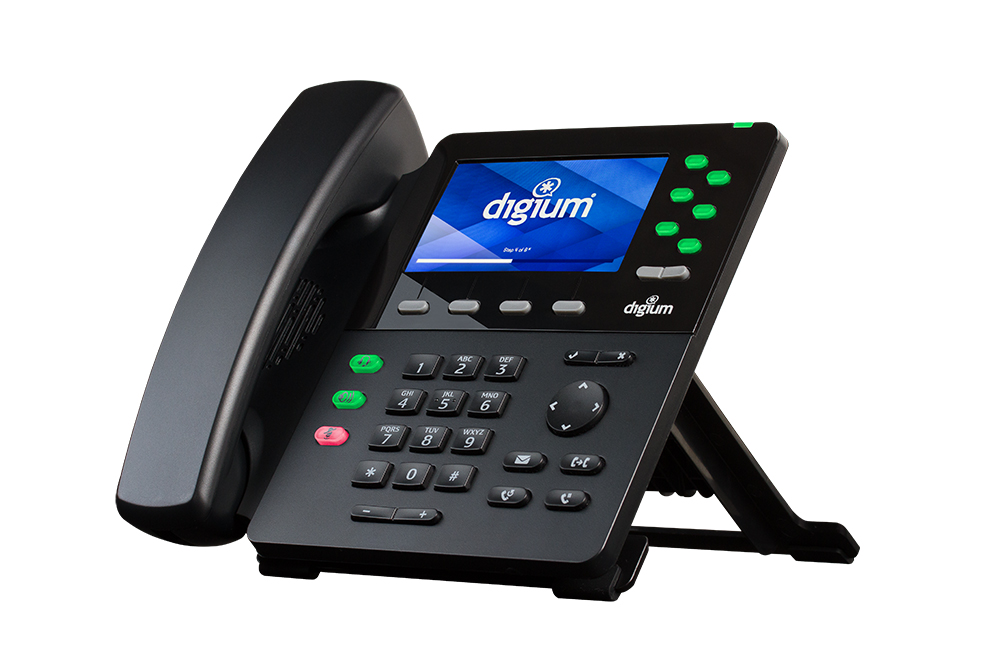
As to answering the question of re-educating the public, I guess I’ll have to leave that question to the head shrinks. As to answering the latter, enriching the PBX experience is both achievable and advisable. When I say enriching, I mainly talk about your ability to bring to the IP phone functionality usually not associated with it. Imagine to have the ability to receive a stock exchange RSS feed to your phones idle screen, notice that you stock is either rising or falling, and by the flick of a button – either sell or buy. We’ve all come accustomed to IP phones that look like the one of the right. A whole bunch of buttons, that in most cases have no direct use when our phone is utilized using a single account. However, these buttons can be externally re-assigned and re-programmed to achieve greater functionality – surpassing the normal behavior of just making phone calls.

The technology involved exists on almost every high-end IP phone on the market (well, at least those made by SNOM, Aastra, Cisco and Polycom – most of the Chinese makers don’t have this) – it’s called a Mini Browsers. Mini Browsers are exactly what they are called, these are simplified versions of your typical Internet browser. Some vendors had produced their own XML based Mini browser markup language (SNOM, Cisco, Aastra) while others had decided to provide a sub-set of XHTML (Polycom). The variations between the vendors are at the neck deep of the problems of using Mini Browsers, and that is that the formats are considerably different. Sure, SNOM had more or less adopted Cisco’s general structure, however, it still varies.

Through the utilization of this technology, it is possible to create phone based browser applications, that seem native to the phone user, as the general interface resembles the native phone interface. It is now the developers job to make the web interface displayed to the user as seamless and as native as possible, keeping in mind that the developer must remain agnostic to the information retrieval layer. Most companies leave their phone systems and these tasks to their system administrators and infrastructure team, however, this task is far beyond their capabilities and skill set. Creating an agnostic IP phone minibrowser dislplay layer, capable of utilizing multiple vendors and models, is a question of content management and content rendering, very must similar to the content transcoding problem that is common to the mobile content world – in other words, a sys-admin will create an ad-hoc solution, a programmer will create a proper, well structured, well designed solution that carry the enterprise beyond its initial needs and requirements.

A short example of how these interfaces work can be found here – on my company blog.

Reblog this post [with Zemanta]

Tags: , , , , , , , , , , , , , , , , ,

03 Dec 09 I’m not rude, I’m eccentric

Polycom, Inc.
Image via Wikipedia

Today I got the chance to speak at a Polycom half-day convention, mainly to speak about Asterisk and HDvoice. Now, putting aside the part about HDvoice (I’m getting a post about that on its own), I gotten to the point where I believe that I’m currently perceived as being an eccentric.

So, why am I eccentric? very simple, I’ve reached a point where I can say things that may be perceived as rude – and write it off an being an eccentric quirk.

I’ve talked about Asterisk ability to support Video, while the current Polycom VVX1500 video phone isn’t yet supported at its fullest. One of the people in the crowd mentioned some sleezy,al-cheapo, SIP Video phone (to be more exact, he’s the local distributor) – and I claimed that I don’t count that phone as a comparison to Polycom or other VoIP Video phones, simply because in my view it’s not a worth while comparison. Comm’on, let’s be realistic, can you compare a Polycom VVX1500 (an HDvoice Video phone) with some shitty sub-VGA SIP Video phone from China? the mere comparison is simply insulting for Polycom.

Shortly after negating that phone, the person stood up and left the room. At the break, a friend said to me that I shouldn’t have said that, in order to come out the bigger man. Common, the guy is surely making a joke of himself. I commented: “I’ve said what I said, I stand by my opinion – besides, you know I’m eccentric – eccentric people say eccentric things” – he agreed that I’m eccentric, after all, you can’t be an Open Source evangelist without being an eccentric – now can you?

Reblog this post [with Zemanta]

Tags: , , , , , , , , , , , , , , ,

15 Oct 09 Astricon 2009 – Glendale, AZ – Part II

Ok, it’s day 1 (or actually day 2) for AstriCon 2009 – and here’s my report for the day.

Yesterday was kind’a of a hectic day for me, as I was teaching a full day track of Asterisk and Cloud Computing, specifically, implementing Asterisk systems with Amazon EC2. I started the day with a class filled with 20+ people, and ended the day with a similar number – so in general I’m very happy. Not many people tend to attend the pre-conference days, so having that number of people and their positive reactions through out the day were very reassuring to me.

If there is one thing I’ve learned from this experience, it is the following: If you give a full day track, don’t arrive at the hotel 24 hours prior to it – you need at least 48 hours! People didn’t really notice (I hope), but through out the day I was suffering from a splitting headache – one that would usually send me right into bed with a couple of Advil’s. But hey, that didn’t stop me and I powered through it, I’m fairly proud of myself for doing so – as at the end of the day I regained back my strength and was livelier.

Today was the first official day of the conference – I gave the opening talk for the Cloud Computing track of the day. My talk was about how to build “IP Centrex” like services, without building an “IP Centrex”. I guess that I didn’t really introduce a brand new concept, but actually talked about something that many are thinking about, but are not inclined to try it on their own and burn some cash on. I guess my talk helped them out saying: “Hey, we’re not talking out of our asses here, this guy makes some sense and what we thought of isn’t that far fetched”.

Previous to that, Digium announced the 2009 Digium innovation award winners, where my company won an award in the pioneer category. This is the second year in a row my company had won the award, and I’m really happy with being acknowledged for this specific work. Having being a part of the community for over 7 years now, this award, at least to me personally, says a lot – it’s basically saying: “Look, you’ve done good, you’ve done some work that really helps out the project and the community in general – here’s a beer and a toast to you – hip hip” – well, that’s kind’a of a mouth full, but you get what I mean. I think that this is actually the place to mention that the award was for developing a high-powered Dialer/IVR platform, used in the Israeli elections and the work was contracted for a company called Shtrudel.

The all conference party is tonight – so I better rest up and be ready for it – should be fun. I guess beer and food are always a good mix when a bunch geeks are getting together :-)

Tags: , , , , , , , , , ,

19 Jul 09 A baby, a house and a full time job

For those of you who know personally, you probably already know that last month I became a father. I guess the transition is something that I was more or less ready for, at least on the technical terms of the transition. However, the thing that completely surprised me was the mental transition – which isn’t even related to the somewhat lack of sleep here and there.

So, here I am, about a month and half away into the final touches to our new home, spending the weekend deploying over 100 meters of CAT-5 cabling in the house – yes the house is network rigged to the teeth. I’m sitting in my daughters room, clamping away the wall sockets for the network, thinking to myself: “hmmmm…. will Nitzan need a single network connection? or should I put at least two for future usage? … hmmmm…. well, I guess time would tell”. In any case, so there I was, spending most of my weekend being my own geeky self, thinking about wiring, networking, wireless exposures, access points, etc. I then go back home, and suddenly, all that disappears the minute I put Nitzan on my shoulder to burp her. It’s really funny, but with her on my shoulder, I guess everything goes away for a few minutes. My brother-in-law informed the house that he caught me burping Nitzan, while sitting at my computer answering emails with the other hand – Ok, so I can’t stop being a geek all together.

In any case, here I am juggling the various aspects of being a father to a new born baby, attending to the various tasks required to final touches of the house (painters, cleaners, air cons, dry walls, etc) and of course, attending to my customers – some of which are completely ambivalent to the fact that I’m under a constant lack of sleep in the past month. Well, I guess in a couple of months Nitzan will start sleeping better, and would make life easier for both me and my wife; in the mean while, we take comfort with the sleep periods my wife gets during the day, so that I can work and cater to my customers, while she caters to Nitzan during the nights – and I have to be honest about this, when it comes to the baby, my wife is the closest thing to a Jedi Knight, her ability to stay focused and clam even when the Nitzan is screaming is amazing – I can’t always do it.

Ok, enough about the house and Nitzan, let’s go back to been geeks for a bit. As you can see on the right hand side of the blog, I’ll be speaking at the up-coming Astricon. I’ll be giving a talk about how to build “IP-Centrex” like installations, utilizing Asterisk and tools like VMWARE, XEN and OpenVZ. However, while my talk may be interesting to you (I hope), my pre-conference tutorial will be much more interesting. I’ll be giving a full day tutorial, teaching people how to install Asterisk in a clouded environment (cloud computing), mainly the Amazon EC2 cloud computing infrastructure. For those of you reading this blog, you may have noticed that I’ve developed a distinct interest in the Amazon EC2 cloud, which I’ve written about several times and also lectured about at Amoocon. While my Amoocon presentation was mainly informational, at Astricon I’ll be primarily teaching you how to do what I did. Well, I won’t be teaching you the inner workings of the GreenfieldTech IVR API framework, although, if you’re gonna ask questions I will answer (especially if you ask the question 3 times, I can’t stand it when people ask the same question 3 times – I just have to answer it – nudge nudge).

Ok, back to fatherhood and Nitzan stuff. The mental transition that I was referring to before is something that I felt last night in its most force. My wife and I decided to go to one of the malls, not far away from our house. So, we entrusted Nitzan with my in-laws and drove to the mall. The mall I’m referring to is called “The seven stars mall” and we like it. It’s not a big mall, but its got this shop called DOMO, that carries these high class cooking ware (my wife and I really like to cook – my chilli con-carne is well known). So, here we were walking the mall, after I ordered a pair of shoes that I needed. So, my wife comments: “You know something, let’s see if there is some sale at Super-Pharm.” – and then we ended up purchasing baby formula, pacifiers and baby wipes. I then asked my wife if she maybe wants to walk into DOMO, but we both didn’t really think about it – suddenly, something that was like a default prior to Nitzan is no longer a default – interesting isn’t it?

In any case, this is how my life looks like at this point in time – and I have to admit that I kind’a like it. Sure, I don’t get as much sleep as I got before, but hey, I’m happy with it – so I just keep on smiling and go on forward.

Reblog this post [with Zemanta]

Tags: , , , , , , ,